
Why Life Isn’t Meant to Stay the Same All Year: The Macrocycle
One of the quiet truths about training is that it often mirrors life more closely than we expect.
One of the most common mistakes in training is believing progress comes from doing the same thing, with the same intent, all year long.
“Train hard. Stay consistent.” It sounds disciplined. It is also incomplete.
Behind the curtain of most well-designed programs in the world is a concept many people never hear about: the macrocycle.
What a Macrocycle Is
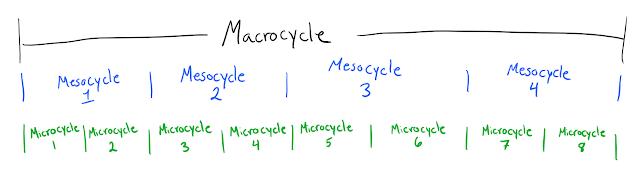
A macrocycle is the big-picture plan. It spans months, sometimes a full year, and is built from smaller phases with different priorities.
You do not train maximal strength, peak conditioning, mobility, and athletic performance all at once. You cycle through them.
This is not a lack of commitment. It is how adaptation actually works.
The body responds best to focused stress followed by change. Staying in one training intent too long leads to stagnation, fatigue, and eventually burnout.
Life works the same way.
Consistency Is Not Sameness
When people say they want consistency, they often mistake this for sameness.
Same workouts. Same schedule. Same expectations.
But sameness is rigidity, not discipline.
True consistency means staying engaged while allowing your focus to shift based on what your life and body require.
Training year-round at the same intensity is not impressive. It is unsustainable. The nervous system gets worn down, joints ache, motivation fades, and progress stalls.
No doubt you’ve experienced this in life; the same thing happens outside the gym.
Life Has Seasons
There are seasons where pushing strength makes sense. Time is available. Stress is manageable. Recovery is solid.
There are seasons where endurance and aerobic capacity matter more. Work demands increase. Energy is split. Training supports capacity instead of peak output.
There are seasons where mobility, maintenance, or simply staying active becomes the priority. Travel, family, or health demands shift the equation.
For some, there is a clear in-season and off-season rhythm. For others, the seasons are less obvious but just as real.
None of these phases are failures. They are normal.
When You Refuse to Cycle
Problems arise when expectations do not change, even though life does.
People push intensity when their body is asking for support.
They judge themselves for not training “like they used to.”
They quit entirely when progress slows instead of adjusting the plan.
In training, as coaches, we would never blame the athlete for a poorly timed program. We would change the cycle.
In life, people internalize the blame. Seemingly, we are our own worst critics.
Taking the Long View
People who train for decades understand this intuitively. They zoom out. They rotate emphasis. They respect recovery and timing. They know that trying to win every phase the same way is a short-term strategy.
The same long view applies to life. The question is not whether you can maintain the same pace forever. It is whether you can adapt without quitting.
So instead of asking, “Why doesn’t this look like it used to?” ask a better question: What season am I in right now, and what does progress look like here?
Sometimes progress means pushing forward. Sometimes it means maintaining. Sometimes it means stepping back so you can move ahead later.
That is not inconsistency. That is a macrocycle at work.
And once you see it in training, you start to see it everywhere.